


Insurance policy for humanoid robots









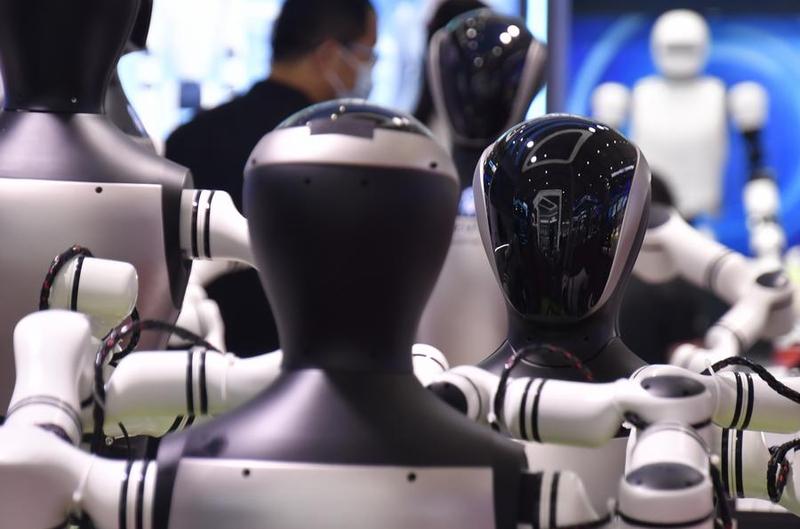
As humanoid robots go from laboratories to factory floors, hospitals, shopping malls and homes, a key question emerges: what if they are damaged or damage others?
In November, Huazhong University of Science and Technology Business Incubator purchased insurance for two 60-kilogram humanoid robots, at a premium of about 5,000 yuan ($707) per robot. If damage occurs within one year, the business incubator will receive a maximum compensation of 500,000 yuan.
This was the first insurance policy for embodied intelligent robots in Hubei province.
The robots will be open for use among university and small and medium-sized enterprises, so frequent testing will raise the risk of falls and collisions, leading to possible damage to the robots and others, according to Zheng Jun, chairman and general manager of Huazhong University of Science and Technology Business Incubator.
"SMEs often cannot afford a robot, and companies who own one may hesitate to use such an expensive machine. Insurance gives developers confidence and can significantly increase usage rates," he said.
The policy covers both physical damage insurance and third-party liability insurance for embodied robots. The former mainly provides coverage for equipment damage caused by natural disasters, fire and explosion, accidental collision, overturning and falling, electrical failures, cybersecurity incidents, abnormal operations and other reasons, according to PICC Property and Casualty Co Ltd's local branch.
The latter offers compensation and dispute resolution services for personal injury or property damage that the robot may cause to third parties during its operation, the company said.
Humanoid robots, like humans, can fall, get injured or even break down. However, the cost of onetime maintenance can range from 30,000 yuan to as much as 300,000 yuan. So the company customized this insurance plan based on research into the needs of enterprises, said She Zhilong, its client manager. "It's just as important as buying medical insurance for humans," he said.
He added many robotics companies have learned about this insurance and are actively in negotiations with the company. "Coverage may be expanded to more application scenarios by expanding insurance liability and liability limits," he said.
Since September, leading insurance companies such as PICC Property and Casualty Co Ltd and China Pacific Property Insurance Co Ltd have put forward related products.
For example, China Pacific Property Insurance released China's first dedicated insurance for the commercial application of humanoid robots in September that covers the whole chain of production, sales, leasing and usage. Ping An Property and Casualty Insurance Co of China rolled out a comprehensive financial solution in November that integrates insurance with credit and IPO services.
"Humanoid robot insurance is not just a risk-transfer tool. It is a 'catalyst' for industrial innovation and a 'stabilizer' for widespread adoption," said Zhou Hua, dean of the School of Insurance at the Central University of Finance and Economics.
Whether manufacturers use insurance as a trust endorsement to enhance market competitiveness or end-users rely on it to resolve concerns over "who is responsible for injuries caused by million-yuan equipment", insurance has become a critical link in overcoming the "last mile" of market adoption, he said.
The risks posed by humanoid robots are complex, including hacking attacks and data breaches, and even ethical liability (algorithmic discrimination). "As robots become deeply integrated into human society, traditional insurance clauses struggle to cover the emerging risks arising from their autonomous decisionmaking capabilities. Therefore, insuring humanoid robots means far more than covering damages to a single machine. It is about building the foundational risk infrastructure for an imminent intelligent society where humans and robots coexist," he said.
However, currently public awareness is limited, and market penetration remains low, as users still question whether the coverage scope is compatible with their needs, and lack the basis for judging the rationality of premium rates, he said.
Wang Guojun, a professor at the School of Insurance and Economics of the University of International Business and Economics, said that a key challenge in developing humanoid robot insurance lies in pricing due to a lack of critical information, such as accident frequency, loss distribution and repair cost schedules. He anticipates that with the establishment of data-sharing platforms and dynamic pricing mechanisms, the insurance market will expand rapidly.
Liu Xueru contributed to this story.