


Rule of law guards sound business environment










As 2025 draws to a close, China's economy has demonstrated strong resilience amid internal and external risks and challenges. With 2026 marking the start of the 15th Five-Year Plan (2026-30), it is crucial to further build a unified domestic market and boost domestic consumption. This necessitates creating an even better business environment, with the rule of law remaining a cornerstone for ensuring such an environment.
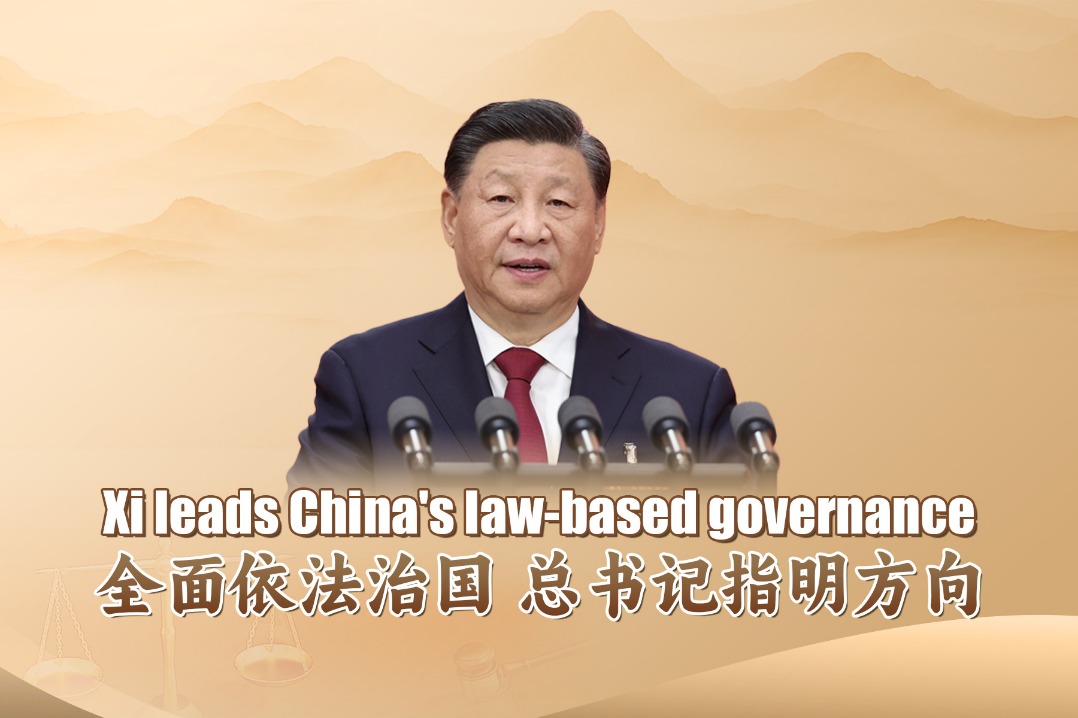
As early as Feb 25, 2019, at an important meeting on law-based governance, Xi Jinping, general secretary of the CPC Central Committee, said that rule of law constitutes the most sound business environment.
Grounded in sound theoretical, practical and historical logic, this guiding remark by Xi underscores the intrinsic link between the rule of law and economic development. It embodies the fundamental principles of economics, jurisprudence and political science.
First of all, the rule of law provides certainty and reduces institutional transaction costs. New institutional economics says that low transaction costs are essential for the efficient functioning of a market economy. By establishing clear, stable and universally applicable rules, the rule of law creates predictable behavioral expectations for all business entities.
This allows business entities to focus on production and technological innovation without diverting resources to cope with uncertainty. This is precisely why the World Bank's assessments across 190 global economies aim at lowering institutional transaction costs for businesses.
The rule of law also defines property rights, thus stimulating the market. Clear delineation of property rights is also critical for market transactions. The rule of law recognizes and protects property rights through a robust legal framework. This assurance gives entrepreneurs the confidence that their investments are secure from arbitrary seizure, fostering an inclusive institutional ecosystem that is a powerful driver of innovation and entrepreneurship.
Moreover, the rule of law promotes law-based administration and shapes a fair competitive environment. At its core, the rule of law means governance by rules, with a sharp focus on regulating and restraining government power.
A flourishing business environment requires the government to be not only a strong regulator but also a credible public service provider that honors its commitments. The rule of law demands that government actions should be legally grounded, eliminating arbitrary intervention, selective enforcement and local protectionism, thereby creating a level playing field for all enterprises.
Equally important, the rule of law protects the legal rights and interests of entities. A well-functioning system that resolves disputes through legal, arbitral and mediation mechanisms is a crucial pillar of market confidence.
When disputes arise, an independent, impartial and efficient resolution system offers effective remedies for aggrieved parties, ensuring that contracts are honored, infringements are redressed and the legal rights and interests of businesses are upheld.
The guiding remark of Xi means that by providing certainty, defining property rights, restraining power and delivering legal remedies, the rule of law builds a predictable and trustworthy institutional framework. This creates a more enduring competitive advantage than any short-term preferential policy.
Guided by the Xi Jinping Thought on the Rule of Law, China has translated these theoretical principles into tangible reality over the past five years through a holistic and systematic approach.
First, the predictability in market rules has been fortified. China has come out with regulations for optimizing the business environment and laid the groundwork for continuous improvements in market access, fair competition and resource allocation mechanisms. One major milestone in this journey was the promulgation of the Civil Code of the People's Republic of China, which codified the essential rules of the market economy and provided a clear legal basis for commercial activities. Complementing the code, the negative list for market access has increased transparency and fairness in China's market entry.
Updates to the Anti-Monopoly Law and Anti-Unfair Competition Law have further reinforced regulation, preventing unchecked expansion of capital and fostering a unified, open, and orderly market where enterprises of all ownership types compete equitably.
Second, property rights protection has been made more effective through the rule of law. China's Constitution explicitly stipulates that lawful private property of citizens is inviolable, establishing the fundamental legal basis for the protection of property rights. The Civil Code of the People's Republic of China, which came into effect in 2021, further reinforced the legal status of various property rights, including real rights, creditor's rights and intellectual property rights.
The Private Sector Promotion Law of the People's Republic of China, which came into force on May 20,2025, declared equal protection for entities under all forms of ownership at the top-level design, thereby enhancing the protection of property rights.
Third, government action has become more predictable through the rule of law. Efforts to advance law-based administration have streamlined approvals and introduced digital governance initiatives such as the one-stop online services, clarifying the scope and process of government authority and balancing state capacity with market vitality.
The State Council has also put in place mechanisms for getting inputs from the public, evaluation by experts, risk analysis, legal reviews and collective decision-making, which prevents arbitrary shifts in policies and enhances consistency. Mechanisms such as administrative reconsideration and open governance, backed by internal and external oversight, help ensure government accountability and credibility.
Fourth, access to legal remedies has been substantially enhanced through the rule of law. Judicial authorities in China have bolstered the adjudication and enforcement of intellectual property (IP) rights cases, with the establishment of specialized IP courts. The raising of the penalties has helped in curbing IP violations.
Wrongful cases involving business environments have also been rectified to avoid conflating economic disputes with criminal conduct, sending a clear message in support of entrepreneurial rights.
The important assertion that "the rule of law is the best business environment" is being implemented across China's vast landscape through scientific legislation, strict law enforcement, impartial judiciary, and widespread adherence to the law. China's significant progress in global business environment rankings is a true reflection of this remarkable achievement.
The author is a professor of law and the vice-president of East China University of Political Science and Law.
The views don't necessarily reflect those of China Daily.
If you have a specific expertise, or would like to share your thought about our stories, then send us your writings at opinion@chinadaily.com.cn, and comment@chinadaily.com.cn.